
Starting point
Researchers from Universiti Sains Malaysia and several industrial partners investigated whether biomass growth and nutrient accumulation could be optimized separately. Instead of using one unchanged nutrient regime throughout the production cycle, they applied a two-stage strategy: one phase prioritizes biomass production, while a second phase adjusts nutrient conditions to influence the final biochemical profile.
The concept is particularly interesting for Wolffia. The team reported that Wolffia globosa reached up to 44.0% protein and 50.7% carbohydrate on a dry-weight basis under prolonged high-nitrogen cultivation. Importantly, laboratory-scale performance could also be reproduced at pilot scale.
This raises a simple but important question: does a production system really need to optimize the same target throughout the entire crop cycle?
What the evidence shows
For industrial applications, separated process phases may be more effective. The first phase could aim at rapid and stable biomass multiplication. A later “finishing” phase could alter the medium to target protein, carbohydrates, lipids, pigments, micronutrients or even microbiome-dependent traits such as vitamin B12.
Post-harvest processing was also shown to be part of product quality rather than an afterthought. In the Malaysian work, drying temperatures between 40 and 55 °C significantly affected nutrient retention, pigment stability, powder properties and suitability for downstream processing. Cultivation therefore does not end at harvest. For powders, functional-food ingredients or extracts, the complete chain from nutrient medium to drying should be treated as one integrated process.
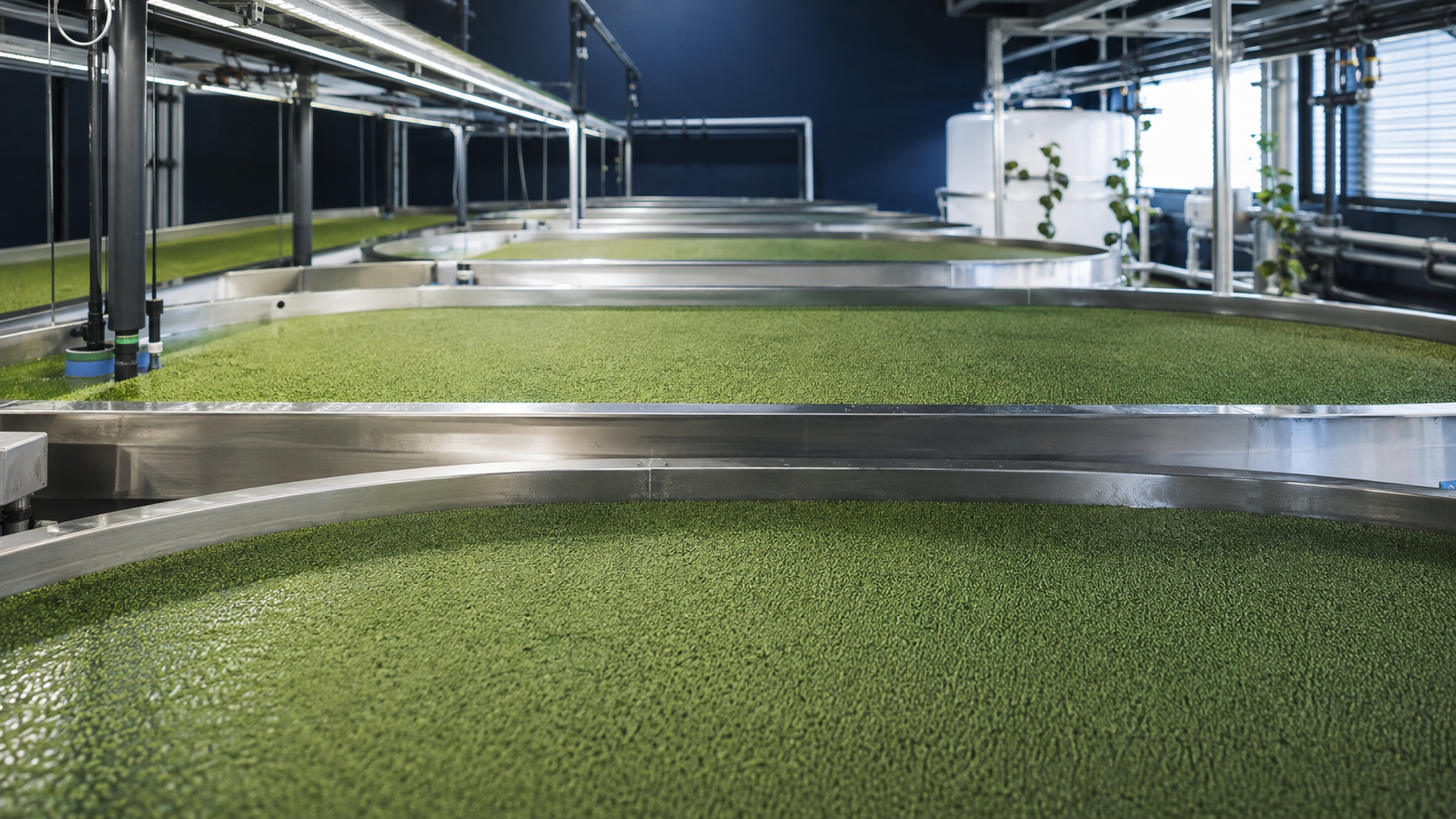
For AquaSphere, this approach is especially relevant to indoor and vertical-farming systems. Closed production environments allow tighter control of nutrient concentrations, pH, temperature, light and residence time than open ponds. This makes differentiated process phases technically realistic: growth, finishing, harvest and gentle stabilization can be designed as distinct production steps.
Practical relevance
The study’s life-cycle analysis adds another important dimension. Electricity use and water production were identified as major environmental hotspots, while the integration of photovoltaic electricity substantially improved the climate balance of Wolffia cultivation. For scaled indoor systems, energy efficiency therefore becomes a core design parameter.
The evidence should be interpreted carefully. These results were presented as an ICDRA 2026 conference contribution and are not yet a fully peer-reviewed publication. The reported values should therefore not be treated as universal production benchmarks.
Nevertheless, the process concept is compelling: Wolffia may not simply be grown; it may be cultivated deliberately toward a defined end product. This combination of biology and process engineering could become a key feature of the next generation of industrial Wolffia systems.