
Context
Described by Tolulope Oyeniran, Bukola Akindipe, and colleagues in an accepted manuscript published by Bioinformatics on 16 October 2026, Deepweed combines AI-powered image segmentation with multi-object tracking. The research includes Wolffia australiana, a close relative of Wolffia globosa, AquaSphere's principal species of interest.
Tracking individuals in a crowded culture
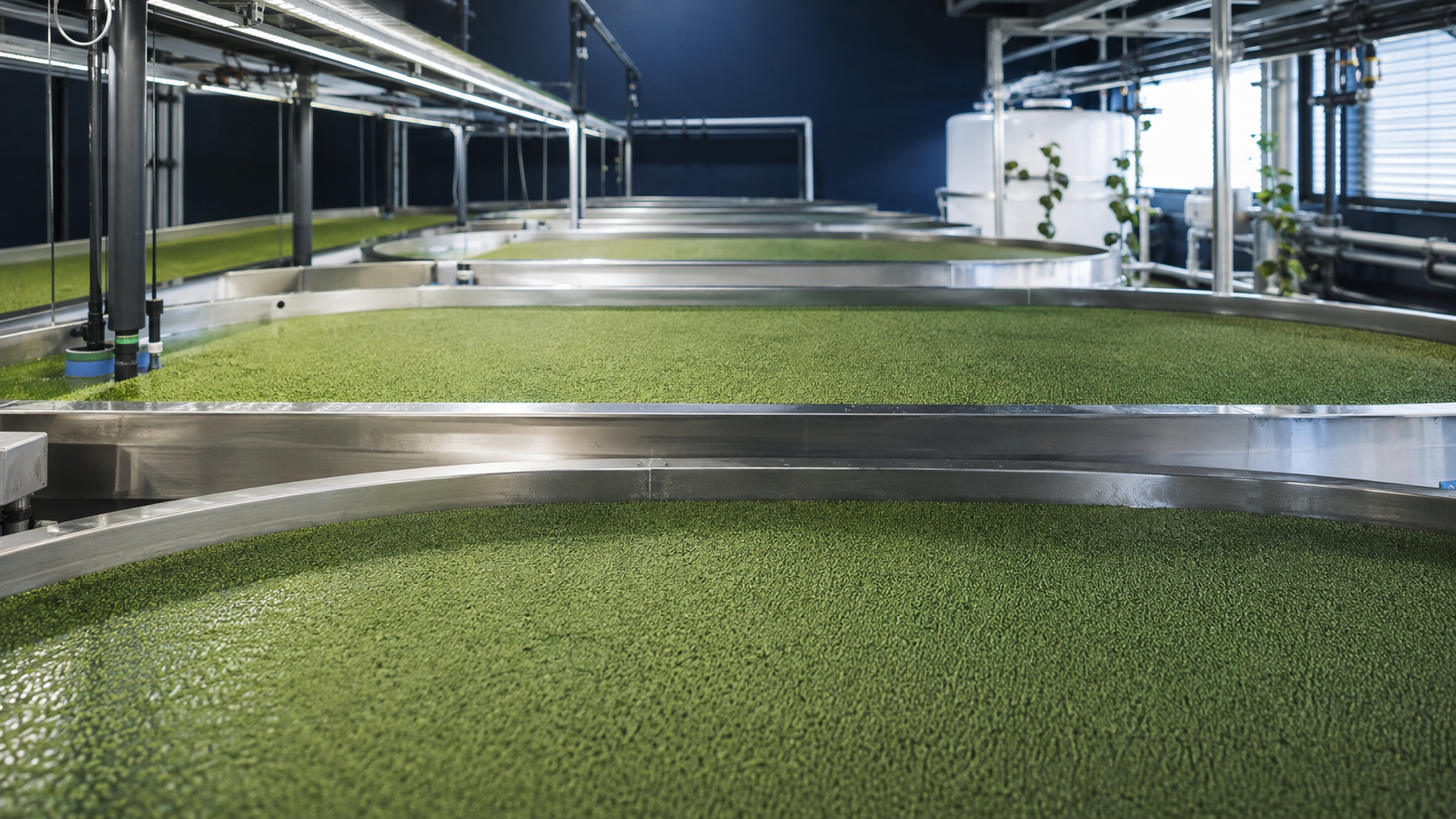
To the naked eye, a mature Wolffia culture can look like a nearly continuous green mat. Deepweed distinguishes individual plants, maintains their identities across time-lapse images, and reconstructs mother–daughter relationships during clonal reproduction.
The software produces individual morphology measurements, population growth summaries, and lineage graphs. Researchers demonstrated its use with dense Wolffia cultures, including controlled microfluidic settings, tracking hundreds of individuals simultaneously.
What was actually demonstrated
The original paper presents a research workflow for time-lapse images of Wolffia, including freely growing cultures and controlled microfluidic experiments. It produces persistent plant identities, individual morphological measurements and reconstructed clonal lineages. This goes beyond measuring the total green area of a culture and allows individual reproductive events to be investigated.
However, the publication does not establish that Deepweed will work without adaptation in an industrial W. globosa rack under varying light, reflections or water flow. A sensible first test would use a small time-lapse dataset checked against manually counted plants. The published code and datasets provide a reproducible starting point.
A promising tool for controlled cultivation
In an indoor or vertical-farming system, this type of imaging could help evaluate how lighting, nutrient media, temperature, or planting density influence growth. Experiments involving different cobalt concentrations could also be monitored for changes in plant development. However, image analysis alone would not show whether vitamin B12 content had changed.
That distinction matters. Deepweed is a growth and morphology tool, not a substitute for chemical analysis, microbiological testing, or food-safety monitoring. Practical deployment would also require checking performance under real production conditions and retraining the model where needed.
Open source creates an opportunity
The researchers have released the source code, trained models, datasets, and documentation. The Python-based workflow uses tools including PyTorch and OpenCV. This openness makes a W. globosa pilot more realistic: a controlled camera setup, consistent lighting, and a small annotated dataset could establish whether the system is reliable on AquaSphere's plants before any attempt at closed-loop automation.
For AquaSphere, Deepweed is not a ready-made factory controller. It is a promising building block for data-driven cultivation research and, potentially, future crop-monitoring systems.
Evidence status: Peer-reviewed, accepted manuscript published 16 October 2026. Demonstrated on Wolffia australiana and Wolffia cultures; not yet established as a validated industrial controller for W. globosa.
Research source: Oyeniran et al., “Deepweed: Automated Individual Segmentation and Tracking for Duckweed Lineage Analysis,” Bioinformatics (2026). https://doi.org/10.1093/bioinformatics/btag779
Code and datasets: https://github.com/SamOliveiraLab/Deepweed